
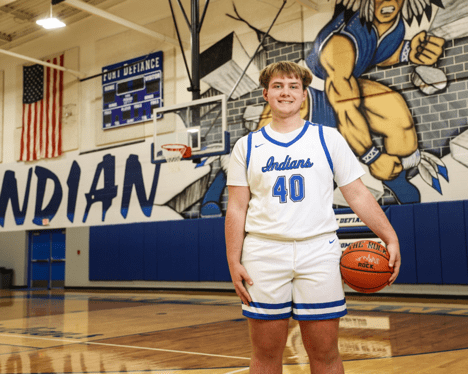
The 2023 – 24 basketball season for Fort Defiance was a trying one. Grandson Gus Gutshall had been promoted to the varsity and my hopes were that he would see significant playing time and do well. The latter ended up being true, not the former. It was very gratifying to see him trying hard on the court, doing what he was expected to do, and somehow trying to adjust to a system that really did not have a place for players of his type. Gus is a good power forward who rebounds well and can score in the paint. But in 2023 – 24 a new coach came, Mike Gale, and with him a new system, the so-called Grinnell System.
Here is a description of the Grinnell System as per Wikipedia:
- The first possible shot is the best possible shot, where three-point field goal attempts are preferred over shorter shots.
- Shoot as many three-pointers as possible.
- In terms of defense, giving up an uncontested layup is better than a shot clock violation.
- Always double team the person with the ball.
- Every player but the shooter goes for the offensive rebound.
- Offensive rebounds should be sent back for another three-point attempt, not a shorter putback for two points.
- Players rotate in and out, generally five at a time, every 1 -2 minutes with all players on the bench seeing action.
So how did this system work? In my opinion, very poorly. The Indians ended with a 11 – 12 season record despite having several good returning players and playing in a much weakened Shenandoah District. Here is my analysis of the system’s pros and cons at Fort Defiance High:
What I consider good about the Grinnell System used at FDHS:
- All kids got to play some. With some coaches, Gus’ playing time would perhaps have been less though it is hard to imagine how that would be true since he spent less time on the court than thirteen of his fourteen teammates.
What I consider bad about the Grinnell System used at FDHS:
- My biggest complaint–players became selfish. The Fort players, even the JV players, quickly caught onto this. Once a player had the ball in his hands, nearly all the time his eyes were on the hoop, not his teammates. Assists were rare in this system. Players did not look for each other. As I said in one game’s report, the players wore the same uniform but were not a team.
- With the emphasis on shooting in the first ten seconds of possession, the quality of shots taken was miserable. Players looked for a shot, not necessarily a good shot. In my opinion, there is no reason for a teenager to be shooting the ball from ten feet beyond the three point arc. This happened repeatedly for FDHS. Even players on the JV team would try shots from beyond 25 feet from the basket. Needless to say, nearly all of these were unsuccessful attempts. I would say these weren’t shots, they were prayers. For the season, Fort Defiance scored more baskets and points with two point field goals (435 made) than three point shots (239 made), quite contrary to the intent of the Grinnell System, but proof that the system did not work as planned.
- If you have several players with good shooting ability, teams can put big points on the board. This is was certainly not true for Fort Defiance. I would not rate a single player of the fourteen on the team as a good shooter. Most don’t even know how to shoot a jump shot–their form is awful. I question whether anyone had ever taught them the mechanics of a proper jump shot. Early in the season I rewatched one of their games and counted the shots taken and made. There were 106 shots taken, 74 of which were misses! In one game! In the final game of the season the team shot 2 for 22 from beyond the three point line in the first half. For the season, Fort made less than 25% of its three point attempts.
- Taller players, potential rebounders, set up away from the basket. Sam Garber, at 6’ 5”, would have been very effective in the paint but he normally was found somewhere beyond the arc, looking for a three pointer to launch.
- When a shot was taken, offensive players crashed the boards, leaving no one back on defense. How many layups did the opponents get this year? Entirely too many to count.
- The pressing defense was grossly ineffective. The Grinnell System places a high priority on causing the opposing team to commit turnovers. Against weak teams, this defense seemed to work OK, but any decent team got three-on-one or three-on-two breaks constantly. In the season’s twenty three games, Fort gave up 80 or more points fifteen times. I’m not sure Fort’s boys ever were taught the basics of playing defense. The Indians tended to play defense with their hands, not their feet.
- The defensive scheme put players in positions wrong for their skills. Gus was assigned to be the point man on the press. Being fleet on foot is not where he excels. And who was back to defend against the (inevitable) fast break? A guard.
- The emphasis on three point shots means other shots were ignored. For example, for the season Fort shot 55% from the foul line. That’s a miserable statistic for any basketball team. As a comparison, last year’s Fort team shot 66% for the year. During one game, I counted 196 three point shots were taken in pregame warmup. Only 4 foul shots were taken. Like his teammates, Gus routinely shot 12 – 15 three pointers in the warmups even though there was 0% chance that he would shoot from beyond the arc during the game. Your foul shooting is not going to improve if you don’t practice it.
- A team’s offensive and defensive strategies should depend on its personnel. Gus is a decent low block forward. He can rebound from that location and score if he gets the ball. Fort’s system had no place for a player like him. By the end of the year, I saw that he rarely tried to post up on a defender because there was little to no chance his teammates would pass to him. They were too busy looking for a shot, good or bad. I complained all year that the only time his hands touched the ball on offense came when he snared a rebound. And Gus wasn’t the only one who didn’t fit this system. Fort’s guards were all driving guards, not guards who could pull up and shoot jump shots. As a result, they would frequently drive into a crowded lane, force up a poor shot, then the opponent would get the rebound and get an easy layup because Fort had no one back on defense.
- In Fort Defiance’s deployment of this system, there was no attention paid to the clock nor the score. If Fort had the lead and gained possession of the ball with 20 seconds to go in a quarter, did they hold the ball for the last shot? Never. Again, the attention seemed to be on shot taking, not good shot taking. In a close game, in my mind, the last thing you’d want to see is a player taking a contested three point shot or go one-on-three into the lane.
- There was no reward for good play nor punishment for repeated mistakes. The only thing that mattered is which five names were called to go in at the next one minute interval. These names seemed to be randomly generated but if that were true Gus would have played much more. I watched games where one guard committed five turnovers in a single period yet was never pulled from the rotation schedule. Likewise, there were times when a player would make two consecutive nice plays only to find himself and his teammates pulled at the next clock stoppage.
- Thanks to this system, the games were not competitive. Fort was blown away by good teams and walloped the poor ones. There were only four games out of twenty three that ended with less than a ten point spread, win or lose. Two of these were in the first five games of the season against Turner Ashby. In every other game except Stuarts Draft and Wilson, by mid fourth quarter or earlier the outcome was well determined. For the season, the median point difference between winner and loser was 20 points!
- Players’ skills did not develop noticeably throughout the season. The Grinnell system puts the emphasis on shot taking, not ball handling, clearly defined plays, or defense. It is highly unlikely that a teenager who isn’t a good shooter in December will be a marksman in February. That was certainly true for FDHS. I actually thought some players regressed as the season progressed.
- With the frenetic style of play, players did not learn when it is better to push the ball on offense and when it is wise to slow down. There is no slowing down so whether it’s four-on-one or one-on-four the goal is to get a shot heaved toward the basket.
- Finally, and importantly, I don’t think the boys liked playing with this system. I could sense some bickering near the end of the season among the team. High fives were rare between players. The fans certainly didn’t like the way Fort played; in almost every game I could hear multiple Fort supporters yelling “Pass the ball!” A high school basketball game should be a fun event for players and fans. The games this year didn’t meet that standard and that is inexcusable.
I wish I were summing up this season writing more pleasantly about how it went. Again, my criticism is of the system, not of Gus and his efforts. In 2022 I wrote the following about how important high school basketball has been in our family: Henry and Gus are members of the fourth consecutive generation in our family who have played high school basketball and played it well. Their great-grandfather, George Hanger, was the star basketball player for Middlebrook in the 1930’s. The next generation had three family members who played high school basketball. I played on an undefeated state championship team at Bramwell (WV) High School in 1967. Truth be told, I was a substitute on that team though I played in every game. The following year, when I was a starter and team captain, we were District (Sectional) Champions and Regional Runners-up. Our record was 19 – 5. In that same generation, Bill Hanger, Henry and Gus’ great-uncle, was a great basketball player for Robert E. Lee High School in Staunton and went on to earn a basketball scholarship at Randolph-Macon College. Bill’s sister Kay Hanger Carter played basketball for Emory and Henry College. In the generation that followed, Henry and Gus’ aunt Kay Henry Hill was a three year starter on the girls team at Fort Defiance High School where she also won a school record six state championships in tennis and volleyball and was named as the Staunton/Waynesboro/Augusta County student athlete of the year. I am so happy that Gus and his brother Henry carried on this tradition.
The season statistics from huddle.com justified my claim that Gus was underused and overlooked this year. He played 148 minutes during the season, next to last of the fourteen boys on the team. The average number of minutes played was 270, nearly twice his time on the court. But look at these statistics: 1) He had the third highest number of offensive rebounds on the team 2) He had the fewest number of turnovers out of the fourteen players 3) His assist/turnover ratio was the best on the team 4) His field goal percentage was third best 5) He committed the fewest fouls on the team 6) Best of all, Huddle produces a statistic called Value Point System. Huddle says “VPS provides an all-encompassing look at how players and teams perform by weighing their positive contributions against their negative ones. The resulting number shows how effective the player is. The Value Point System comes from a formula that factors in several counting stats to produce a number that gives a more well-rounded indication of overall performance.” Gus had, by far, the highest VPS score on the team. So why was a player judged to be the most effective on the team allowed to be on the court for fewer minutes than all of his teammates except one? I’d like to brag that this is the second year in a row a Gutshall boy has had the highest VPS on his team; last year Henry had that honor.
For twenty three nights I watched Gus participate with and contribute to this team. And on twenty three occasions I wrote about the games and complained about how things were going. I hope his memories of this season are of his contributions and not of the unpleasantries I’ve written about.
Being on a team and doing your part is an important life skill to learn. I am happy that Gus had this opportunity; I just wish it had been a more enjoyable year for him. For most games he had a loyal following of from six to twelve family members who enjoyed watching him play. All of us were exceptionally proud to see #40 on the court giving it his best.
Joe Hill
 Joe Hill's Family Website